UI / UX Design
Favorites
Enabled Workday Scheduling managers to seamlessly save, access, and switch between frequently used schedule views to improve efficiency, accuracy, and workflow fluidity
Role :
UX Lead (Discovery, Interaction Design, Validation)
Tools :
Figma, Miro, User Interviews, Analytics Review
Team :
UX, Product, Engineering
Methods :
User Interviews, Behavioral Analysis, Rapid Prototyping, Usability Testing

📌 Project Overview :
Scheduling managers frequently rely on highly specific filter combinations to manage different workforce scenarios throughout the day. However, switching between these contexts required dismantling and rebuilding complex filter sets repeatedly, creating unnecessary friction and wasted time.
For example, a manager responsible for Frontline Cashiers from 9am–1pm may rely on a specific combination of role, division, and time filters. Later, that same manager may need to check Weekend Day Shift Coverage, which requires an entirely different configuration. Without a way to save and quickly toggle between these views, managers were forced into repetitive manual reconfiguration — shifting their focus from strategic workforce management to interface manipulation.
Project Details
Product: Workforce Scheduling – Manager Tools
Scope: Creation of a scalable “Favorites” framework allowing managers to save and quickly access frequently used filtered views
Methods: Workflow analysis, feature definition, interaction design, iterative refinement
Platforms: Web (Desktop SaaS Application)
Problem: Managers relied on complex filtered views for recurring scheduling scenarios, requiring repetitive setup and increasing time-to-task.

💻 Final Design :
Filter Favorites to Create a New Favorite (Week View)
Demonstrates how users filter and group shifts in Week view, then save a customized configuration as a reusable Favorite for faster scheduling.
Rename a Favorite (Week View)
Shows how users manage existing Favorites by editing the label inline, reinforcing flexibility and quick iteration without disrupting workflow.
Filter Favorites to Create a New Favorite (Day View)
Highlights the ability to switch views, apply filters and sorting in Day view, and save tailored configurations as Favorites for repeat use.
Delete a Favorite
Illustrates how users manage and remove saved Favorites directly from the Manage menu, keeping their workspace organized and relevant.
The final solution introduced a scalable Favorites system within Month, Day and Week Schedule views that enables managers to:
Save complex filter configurations
Quickly toggle between operational contexts
Edit and manage saved views
Receive confirmation feedback upon creation
The interaction model prioritizes clarity, predictability, and low cognitive overhead. By embedding Favorites directly into the scheduling workflow, the feature enhances speed without introducing visual noise.
🔍 Exploration & Discovery :
Through workflow observation and stakeholder discussions, it became clear that managers were performing repeated filtering tasks dozens of times per day. While filters technically persisted within a session, they did not support rapid context switching across different operational needs.
Core friction points included:
Repetitive manual filter reconfiguration
Increased cognitive load from remembering filter combinations
Time lost navigating between operational scenarios
Higher risk of human error when rebuilding filter sets
Underutilization of advanced filtering capabilities
This friction not only slowed productivity but discouraged deeper engagement with schedule data.
Driving Factors
The Favorites feature was driven by three primary pillars: efficiency, data accuracy, and business value.
1. Improve User Efficiency & Reduce Repetitive Work
The primary driver was time savings. By allowing managers to save complex filter combinations and access them in one click, we removed dozens of repetitive interactions from their daily workflow.
Key efficiency outcomes targeted:
Reduced time on task
Reduced cognitive strain
Faster context switching
Streamlined workflow transitions
Managers no longer needed to remember exact filter configurations, freeing mental bandwidth for higher-value decision-making.
2. Enhance Data Accessibility & Accuracy
Manually reapplying multiple filters increases the likelihood of mistakes — such as missing a filter or selecting the wrong option. Saved Favorites act as a reliable source of truth for a specific operational view.
This design decision:
Encourages deeper engagement with schedule data
Improves staffing and labor cost decisions
Reduces human error
Empowers managers to tailor the tool to their operational context
A retail manager and hospital manager have different priorities; Favorites enables personalization at scale.
3. Strategic & Business Value
Beyond usability, Favorites contributes directly to product strategy.
Increased Product Stickiness: The more personalized a manager’s workflow becomes, the more embedded Workday Scheduling is in their daily operations — increasing retention and reducing churn.
Drive Adoption of Advanced Filtering: Simplifies access to powerful filtering capabilities that may otherwise feel cumbersome.
Foundation for Future Enhancements:
Sharable Views
Default Views upon login
Automated alerts based on saved criteria
Favorites establishes infrastructure that supports future roadmap expansion.
✏️ Design Process :
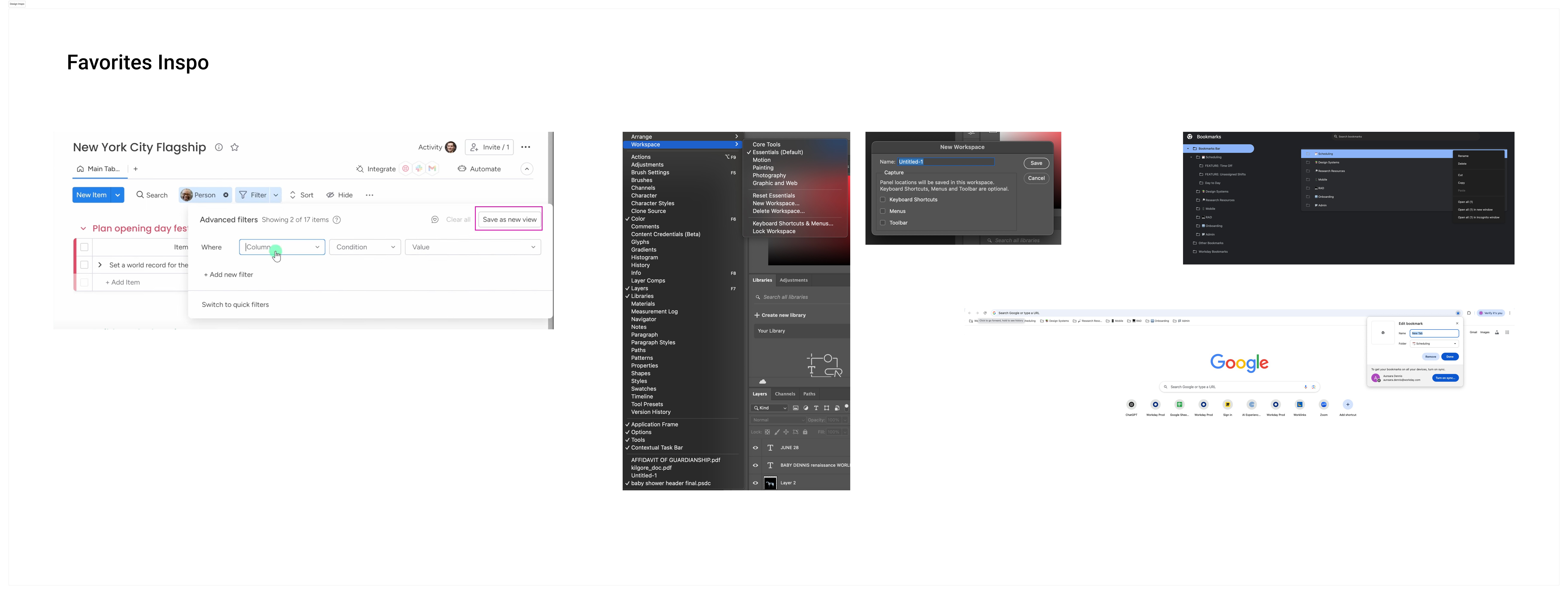
I began by researching Saved View and Favorites patterns across other scheduling platforms, as well as existing Workday products, to ensure visual and interaction consistency. This helped prevent introducing a treatment that felt foreign within the broader Workday ecosystem.
From there, I explored multiple interaction models to determine how Favorites would live within the Day and Week schedule views without disrupting existing workflows. A key design consideration was balancing visibility with minimal UI clutter — the feature needed to be powerful but not overwhelming.
Scope constraints shaped early design decisions. MVP requirements included:
Create Favorite view (Day and Week)
Edit Favorite name
Delete Favorite
Confirmation states
10 Favorite limit
Character limit for naming
Out of scope for MVP:
Overwriting an existing Favorite
Sharing Favorites
Setting a default Favorite (MVP persists last selected view)
Because Sort and Filter options vary slightly between Day, Week, and Month views, clear communication was essential to prevent confusion around where Favorites applied. I partnered closely with Product and Engineering to clarify system logic and ensure consistency across views.
To measure impact, we defined behavioral success indicators and planned UXI tagging for:
Click frequency on Favorites menu
Save/Create Favorite modal interactions
Manage (Edit/Delete) interactions
We also accounted for interpretation risk — high click frequency could indicate success or confusion. Measurement strategy was designed to distinguish between efficient toggling and frustrated switching behavior.
Accessibility and inclusion were integrated early in the design process. I collaborated with Accessibility to validate keyboard flows, screen reader labeling, and focus states to support non-sighted users. I also leveraged Figma’s Phrase TMS globalization plugin to evaluate label expansion in longer languages and tested layouts for tablet and smaller desktop contexts.
📈 Impact :
Favorites directly improved workflow efficiency and reduced friction in daily scheduling tasks.
Behavioral Metrics
Increased frequency of saved view usage
Reduction in repetitive filter reconfiguration
Higher engagement with advanced filtering
Usability Outcomes
Reduced cognitive load
Reduced risk of filter misconfiguration
Faster context switching
Strategic Impact
Increased product personalization
Strengthened platform retention through workflow embedding
Established foundation for sharable views and alert-based automation
More Projects




UI / UX Design
Favorites
Enabled Workday Scheduling managers to seamlessly save, access, and switch between frequently used schedule views to improve efficiency, accuracy, and workflow fluidity
Role :
UX Lead (Discovery, Interaction Design, Validation)
Tools :
Figma, Miro, User Interviews, Analytics Review
Team :
UX, Product, Engineering
Methods :
User Interviews, Behavioral Analysis, Rapid Prototyping, Usability Testing
📌 Project Overview :
Scheduling managers frequently rely on highly specific filter combinations to manage different workforce scenarios throughout the day. However, switching between these contexts required dismantling and rebuilding complex filter sets repeatedly, creating unnecessary friction and wasted time.
For example, a manager responsible for Frontline Cashiers from 9am–1pm may rely on a specific combination of role, division, and time filters. Later, that same manager may need to check Weekend Day Shift Coverage, which requires an entirely different configuration. Without a way to save and quickly toggle between these views, managers were forced into repetitive manual reconfiguration — shifting their focus from strategic workforce management to interface manipulation.
Project Details
Product: Workforce Scheduling – Manager Tools
Scope: Creation of a scalable “Favorites” framework allowing managers to save and quickly access frequently used filtered views
Methods: Workflow analysis, feature definition, interaction design, iterative refinement
Platforms: Web (Desktop SaaS Application)
Problem: Managers relied on complex filtered views for recurring scheduling scenarios, requiring repetitive setup and increasing time-to-task.
💻 Final Design :
Filter Favorites to Create a New Favorite (Week View)
Demonstrates how users filter and group shifts in Week view, then save a customized configuration as a reusable Favorite for faster scheduling.
Rename a Favorite (Week View)
Shows how users manage existing Favorites by editing the label inline, reinforcing flexibility and quick iteration without disrupting workflow.
Filter Favorites to Create a New Favorite (Day View)
Highlights the ability to switch views, apply filters and sorting in Day view, and save tailored configurations as Favorites for repeat use.
Delete a Favorite
Illustrates how users manage and remove saved Favorites directly from the Manage menu, keeping their workspace organized and relevant.
The final solution introduced a scalable Favorites system within Month, Day and Week Schedule views that enables managers to:
Save complex filter configurations
Quickly toggle between operational contexts
Edit and manage saved views
Receive confirmation feedback upon creation
The interaction model prioritizes clarity, predictability, and low cognitive overhead. By embedding Favorites directly into the scheduling workflow, the feature enhances speed without introducing visual noise.
🔍 Exploration & Discovery :
Through workflow observation and stakeholder discussions, it became clear that managers were performing repeated filtering tasks dozens of times per day. While filters technically persisted within a session, they did not support rapid context switching across different operational needs.
Core friction points included:
Repetitive manual filter reconfiguration
Increased cognitive load from remembering filter combinations
Time lost navigating between operational scenarios
Higher risk of human error when rebuilding filter sets
Underutilization of advanced filtering capabilities
This friction not only slowed productivity but discouraged deeper engagement with schedule data.
Driving Factors
The Favorites feature was driven by three primary pillars: efficiency, data accuracy, and business value.
1. Improve User Efficiency & Reduce Repetitive Work
The primary driver was time savings. By allowing managers to save complex filter combinations and access them in one click, we removed dozens of repetitive interactions from their daily workflow.
Key efficiency outcomes targeted:
Reduced time on task
Reduced cognitive strain
Faster context switching
Streamlined workflow transitions
Managers no longer needed to remember exact filter configurations, freeing mental bandwidth for higher-value decision-making.
2. Enhance Data Accessibility & Accuracy
Manually reapplying multiple filters increases the likelihood of mistakes — such as missing a filter or selecting the wrong option. Saved Favorites act as a reliable source of truth for a specific operational view.
This design decision:
Encourages deeper engagement with schedule data
Improves staffing and labor cost decisions
Reduces human error
Empowers managers to tailor the tool to their operational context
A retail manager and hospital manager have different priorities; Favorites enables personalization at scale.
3. Strategic & Business Value
Beyond usability, Favorites contributes directly to product strategy.
Increased Product Stickiness: The more personalized a manager’s workflow becomes, the more embedded Workday Scheduling is in their daily operations — increasing retention and reducing churn.
Drive Adoption of Advanced Filtering: Simplifies access to powerful filtering capabilities that may otherwise feel cumbersome.
Foundation for Future Enhancements:
Sharable Views
Default Views upon login
Automated alerts based on saved criteria
Favorites establishes infrastructure that supports future roadmap expansion.
✏️ Design Process :
I began by researching Saved View and Favorites patterns across other scheduling platforms, as well as existing Workday products, to ensure visual and interaction consistency. This helped prevent introducing a treatment that felt foreign within the broader Workday ecosystem.
From there, I explored multiple interaction models to determine how Favorites would live within the Day and Week schedule views without disrupting existing workflows. A key design consideration was balancing visibility with minimal UI clutter — the feature needed to be powerful but not overwhelming.
Scope constraints shaped early design decisions. MVP requirements included:
Create Favorite view (Day and Week)
Edit Favorite name
Delete Favorite
Confirmation states
10 Favorite limit
Character limit for naming
Out of scope for MVP:
Overwriting an existing Favorite
Sharing Favorites
Setting a default Favorite (MVP persists last selected view)
Because Sort and Filter options vary slightly between Day, Week, and Month views, clear communication was essential to prevent confusion around where Favorites applied. I partnered closely with Product and Engineering to clarify system logic and ensure consistency across views.
To measure impact, we defined behavioral success indicators and planned UXI tagging for:
Click frequency on Favorites menu
Save/Create Favorite modal interactions
Manage (Edit/Delete) interactions
We also accounted for interpretation risk — high click frequency could indicate success or confusion. Measurement strategy was designed to distinguish between efficient toggling and frustrated switching behavior.
Accessibility and inclusion were integrated early in the design process. I collaborated with Accessibility to validate keyboard flows, screen reader labeling, and focus states to support non-sighted users. I also leveraged Figma’s Phrase TMS globalization plugin to evaluate label expansion in longer languages and tested layouts for tablet and smaller desktop contexts.
📈 Impact :
Favorites directly improved workflow efficiency and reduced friction in daily scheduling tasks.
Behavioral Metrics
Increased frequency of saved view usage
Reduction in repetitive filter reconfiguration
Higher engagement with advanced filtering
Usability Outcomes
Reduced cognitive load
Reduced risk of filter misconfiguration
Faster context switching
Strategic Impact
Increased product personalization
Strengthened platform retention through workflow embedding
Established foundation for sharable views and alert-based automation
More Projects
UI / UX Design
Favorites
Enabled Workday Scheduling managers to seamlessly save, access, and switch between frequently used schedule views to improve efficiency, accuracy, and workflow fluidity
Role :
UX Lead (Discovery, Interaction Design, Validation)
Tools :
Figma, Miro, User Interviews, Analytics Review
Team :
UX, Product, Engineering
Methods :
User Interviews, Behavioral Analysis, Rapid Prototyping, Usability Testing
📌 Project Overview :
Scheduling managers frequently rely on highly specific filter combinations to manage different workforce scenarios throughout the day. However, switching between these contexts required dismantling and rebuilding complex filter sets repeatedly, creating unnecessary friction and wasted time.
For example, a manager responsible for Frontline Cashiers from 9am–1pm may rely on a specific combination of role, division, and time filters. Later, that same manager may need to check Weekend Day Shift Coverage, which requires an entirely different configuration. Without a way to save and quickly toggle between these views, managers were forced into repetitive manual reconfiguration — shifting their focus from strategic workforce management to interface manipulation.
Project Details
Product: Workforce Scheduling – Manager Tools
Scope: Creation of a scalable “Favorites” framework allowing managers to save and quickly access frequently used filtered views
Methods: Workflow analysis, feature definition, interaction design, iterative refinement
Platforms: Web (Desktop SaaS Application)
Problem: Managers relied on complex filtered views for recurring scheduling scenarios, requiring repetitive setup and increasing time-to-task.
💻 Final Design :
Filter Favorites to Create a New Favorite (Week View)
Demonstrates how users filter and group shifts in Week view, then save a customized configuration as a reusable Favorite for faster scheduling.
Rename a Favorite (Week View)
Shows how users manage existing Favorites by editing the label inline, reinforcing flexibility and quick iteration without disrupting workflow.
Filter Favorites to Create a New Favorite (Day View)
Highlights the ability to switch views, apply filters and sorting in Day view, and save tailored configurations as Favorites for repeat use.
Delete a Favorite
Illustrates how users manage and remove saved Favorites directly from the Manage menu, keeping their workspace organized and relevant.
The final solution introduced a scalable Favorites system within Month, Day and Week Schedule views that enables managers to:
Save complex filter configurations
Quickly toggle between operational contexts
Edit and manage saved views
Receive confirmation feedback upon creation
The interaction model prioritizes clarity, predictability, and low cognitive overhead. By embedding Favorites directly into the scheduling workflow, the feature enhances speed without introducing visual noise.
🔍 Exploration & Discovery :
Through workflow observation and stakeholder discussions, it became clear that managers were performing repeated filtering tasks dozens of times per day. While filters technically persisted within a session, they did not support rapid context switching across different operational needs.
Core friction points included:
Repetitive manual filter reconfiguration
Increased cognitive load from remembering filter combinations
Time lost navigating between operational scenarios
Higher risk of human error when rebuilding filter sets
Underutilization of advanced filtering capabilities
This friction not only slowed productivity but discouraged deeper engagement with schedule data.
Driving Factors
The Favorites feature was driven by three primary pillars: efficiency, data accuracy, and business value.
1. Improve User Efficiency & Reduce Repetitive Work
The primary driver was time savings. By allowing managers to save complex filter combinations and access them in one click, we removed dozens of repetitive interactions from their daily workflow.
Key efficiency outcomes targeted:
Reduced time on task
Reduced cognitive strain
Faster context switching
Streamlined workflow transitions
Managers no longer needed to remember exact filter configurations, freeing mental bandwidth for higher-value decision-making.
2. Enhance Data Accessibility & Accuracy
Manually reapplying multiple filters increases the likelihood of mistakes — such as missing a filter or selecting the wrong option. Saved Favorites act as a reliable source of truth for a specific operational view.
This design decision:
Encourages deeper engagement with schedule data
Improves staffing and labor cost decisions
Reduces human error
Empowers managers to tailor the tool to their operational context
A retail manager and hospital manager have different priorities; Favorites enables personalization at scale.
3. Strategic & Business Value
Beyond usability, Favorites contributes directly to product strategy.
Increased Product Stickiness: The more personalized a manager’s workflow becomes, the more embedded Workday Scheduling is in their daily operations — increasing retention and reducing churn.
Drive Adoption of Advanced Filtering: Simplifies access to powerful filtering capabilities that may otherwise feel cumbersome.
Foundation for Future Enhancements:
Sharable Views
Default Views upon login
Automated alerts based on saved criteria
Favorites establishes infrastructure that supports future roadmap expansion.
✏️ Design Process :
I began by researching Saved View and Favorites patterns across other scheduling platforms, as well as existing Workday products, to ensure visual and interaction consistency. This helped prevent introducing a treatment that felt foreign within the broader Workday ecosystem.
From there, I explored multiple interaction models to determine how Favorites would live within the Day and Week schedule views without disrupting existing workflows. A key design consideration was balancing visibility with minimal UI clutter — the feature needed to be powerful but not overwhelming.
Scope constraints shaped early design decisions. MVP requirements included:
Create Favorite view (Day and Week)
Edit Favorite name
Delete Favorite
Confirmation states
10 Favorite limit
Character limit for naming
Out of scope for MVP:
Overwriting an existing Favorite
Sharing Favorites
Setting a default Favorite (MVP persists last selected view)
Because Sort and Filter options vary slightly between Day, Week, and Month views, clear communication was essential to prevent confusion around where Favorites applied. I partnered closely with Product and Engineering to clarify system logic and ensure consistency across views.
To measure impact, we defined behavioral success indicators and planned UXI tagging for:
Click frequency on Favorites menu
Save/Create Favorite modal interactions
Manage (Edit/Delete) interactions
We also accounted for interpretation risk — high click frequency could indicate success or confusion. Measurement strategy was designed to distinguish between efficient toggling and frustrated switching behavior.
Accessibility and inclusion were integrated early in the design process. I collaborated with Accessibility to validate keyboard flows, screen reader labeling, and focus states to support non-sighted users. I also leveraged Figma’s Phrase TMS globalization plugin to evaluate label expansion in longer languages and tested layouts for tablet and smaller desktop contexts.
📈 Impact :
Favorites directly improved workflow efficiency and reduced friction in daily scheduling tasks.
Behavioral Metrics
Increased frequency of saved view usage
Reduction in repetitive filter reconfiguration
Higher engagement with advanced filtering
Usability Outcomes
Reduced cognitive load
Reduced risk of filter misconfiguration
Faster context switching
Strategic Impact
Increased product personalization
Strengthened platform retention through workflow embedding
Established foundation for sharable views and alert-based automation